
Best Heishi Bead Colors for Fall Bracelets
What are the best heishi bead colors for fall bracelets?
Rust, mustard, olive, cream, and terracotta make the strongest fall heishi palette. These warm, earthy tones sit close together on the color wheel, so they layer into a stack without fighting each other, and each one pulls double duty as a neutral or an accent depending on what it's paired with.
Heishi beads are flat, disc-shaped beads that stack tight with almost no gap between them, which is exactly why color matters so much on a heishi bracelet. There's no clasp charm or spacer bead breaking things up. It's color against color, strand after strand. Pick the right combination and a simple bracelet looks pulled together. Pick the wrong one and it just looks muddy.
Why do warm tones work so well together in a fall bracelet stack?
Warm tones like rust, mustard, and terracotta sit next to each other on the color wheel, which is why they blend instead of clash. Colors that are close together, called analogous colors in basic color theory, share enough undertone that they read as a family even when the shades themselves are pretty different.
That's different from pairing something like bright mustard with cool navy, where you're relying on contrast to make the pairing work. Fall palettes lean the other way. Rust, olive, mustard, and terracotta all carry some version of orange, brown, or yellow underneath, so a bracelet mixing all four still looks like one cohesive piece instead of four separate ideas stacked on a wrist.
How do you combine rust, mustard, and olive without clashing?
Pick one color to lead and let the other two play supporting roles. A bracelet that's mostly rust, with just a few beads of mustard and olive mixed in, reads as intentional. Three bold colors fighting for equal space on the same strand usually just looks busy.
A few ways to keep the ratio working in your favor.
- Lead with one dominant color and use the other two as accents, roughly 60/20/20.
- Group same-color beads in short runs of two or three instead of alternating one by one, which tends to look choppy.
- Save your boldest color, usually mustard, for the smallest amount since it reads loudest.
- If a combo still feels off, drop one color and let the other two carry the whole bracelet.
What's the role of a neutral like cream or ivory in a fall palette?
Cream or ivory heishi is the easiest neutral to work into a fall stack. It gives your eye a place to rest between saturated colors like rust and olive, and it keeps a bold palette from feeling heavy on the wrist.
Think of cream as the pause between sentences. A bracelet that's wall-to-wall rust and olive can start to feel dense after a few inches. Break it up with cream every so often and the whole thing opens up. Terracotta works a little differently. It's warm enough to blend with rust and mustard but muted enough to act almost like a second neutral, which makes it one of the more flexible colors in a fall rotation.
What are some fall heishi bracelet stack ideas you can try?
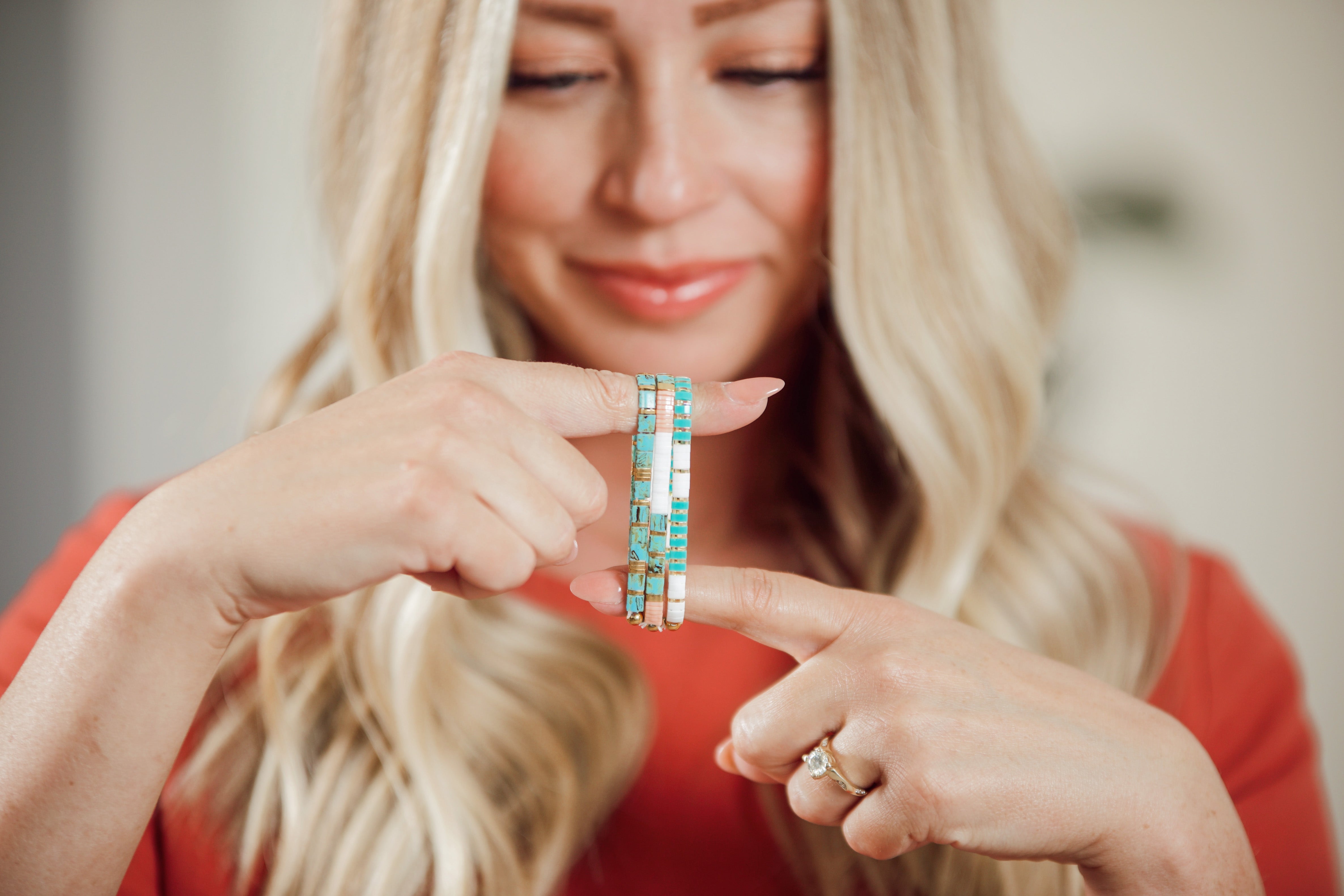
A good fall stack usually mixes two or three heishi colors with a plain accent bracelet or two to round it out. Here are a few combinations worth starting with.
- Rust, cream, and gold accent: rust-heavy heishi broken up with cream, plus a slim gold-tone accent bracelet for a little shine.
- Olive and mustard duo: olive as the lead color with mustard mixed in short runs, no neutral needed if you want something bolder.
- Terracotta and cream: a quieter, more wearable pairing that works for everyday stacking, not just an occasion piece.
- Full harvest mix: rust, mustard, olive, and terracotta layered across two or three separate bracelets rather than crammed onto one strand.
- Cream base with rotating accents: a mostly cream bracelet as your anchor piece, then swap in a rust or olive bracelet depending on the day.
You can shop heishi beads in these fall shades directly and build a stack around whichever combination fits your closet best.
What are heishi beads made of?
Most heishi beads sold today are polymer clay, a flexible material that takes color well and holds a precise flat disc shape. Older, traditional heishi were cut from shell or stone, but polymer clay is what gives modern bracelets their wide range of fall-friendly colors.
According to background on the style's origins and history, heishi dates back centuries in Southwestern jewelry making, long before clay versions existed. Polymer clay is a synthetic modeling material that cures into a durable, lightweight bead, which is part of why it's become the standard for colorful heishi today. Mack & Rex sells polymer clay heishi beads in the shades covered above. We don't manufacture the beads ourselves, we source and curate them, which is what lets us put together a focused fall lineup instead of a generic grab bag of colors.
Can kids help make fall heishi bracelets?
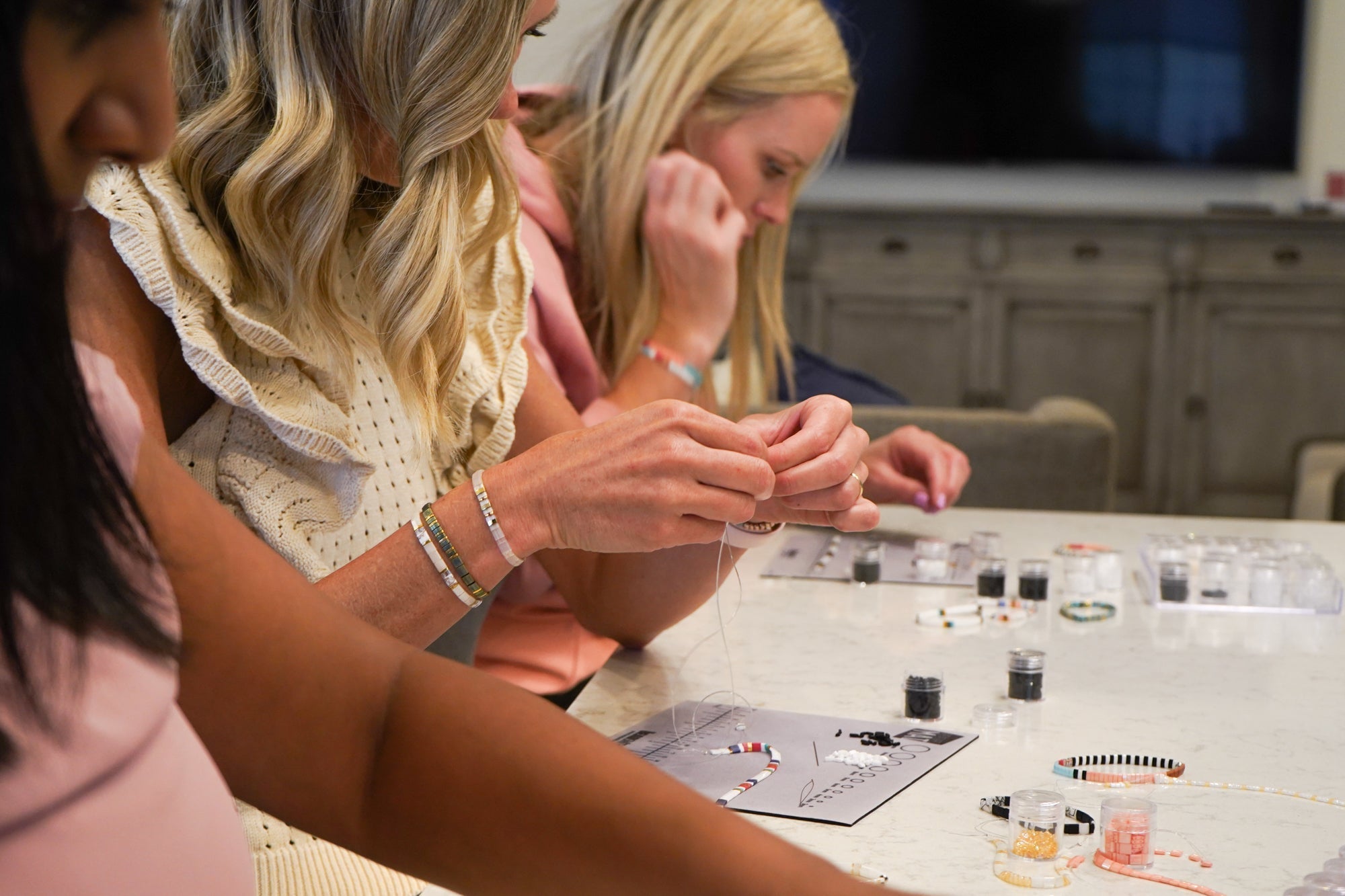
Kids can help pick colors and string beads with an adult nearby, since heishi beads are small and a choking hazard for young children. Keep loose beads away from babies and toddlers, and treat bracelet-making as a together activity rather than one to hand off unsupervised.
Picking a fall palette is actually a fun way to get kids involved without handing over the whole project. Let them choose between rust and olive, or decide how much mustard goes in. The color decisions are low-stakes and easy for a kid to have an opinion on, while an adult handles the stringing and keeps loose beads off the floor and away from little hands.
Where can you shop heishi beads in fall colors at Mack & Rex?
You can browse the current heishi bead collection at Mack & Rex, where loose bead mixes typically run around $5 to $9 depending on the pack. Rust, mustard, olive, cream, and terracotta mixes tend to show up right as the season turns, so it's worth checking back if your favorite shade isn't in stock yet.
If you'd rather skip the stringing and go straight to a finished piece, Mack & Rex also sells ready-to-wear bracelets in seasonal colors, and buying three finished bracelets gets you a fourth free, no code needed (that offer applies to finished bracelets, not loose bead mixes). Orders ship internationally, with shipping and any customs costs calculated at checkout, and free shipping on US orders over $100.
Frequently Asked Questions
What are the best heishi bead colors for fall bracelets?
Rust, mustard, olive, cream, and terracotta make the strongest fall heishi palette. These warm, earthy tones sit close together on the color wheel, so they layer into a stack without fighting each other, and each one pulls double duty as a neutral or an accent depending on what it's paired with.
How do I mix rust, mustard, and olive heishi beads without them clashing?
Pick one color to lead the stack and let the other two play supporting roles in smaller amounts. A bracelet that's mostly rust with a few mustard and olive accents reads as intentional, while three bold colors fighting for equal space tends to look busy.
What's the best neutral to pair with fall heishi colors?
Cream or ivory heishi is the easiest neutral to work into a fall stack. It gives your eye a place to rest between saturated colors like rust and olive, and it keeps a bold palette from feeling heavy on the wrist.
What are heishi beads made of?
Most heishi beads sold today are polymer clay, a flexible material that takes color well and holds a precise flat disc shape. Older and more traditional heishi were cut from shell or stone, but polymer clay is what gives modern bracelets their wide range of fall-friendly colors.
Can kids help make fall heishi bracelets?
Kids can help pick colors and string beads with an adult nearby, since heishi beads are small and a choking hazard for young children. Keep loose beads away from babies and toddlers, and treat bracelet-making as a together activity rather than one to hand off unsupervised.