


Buying Charms for Stretch Bracelets: Where to Shop and What Actually Fits
Where can I buy charms for beaded bracelets?
You can buy bracelet charms from bead and jewelry-supply shops, craft stores, online marketplaces, and shops like Mack & Rex that sell charms made for stretch bracelets. Wherever you shop, check the hole or bail size against your elastic cord (usually 0.7 to 1.0 mm) before you add anything to the cart.
That second part is where most people get burned. A charm can be adorable and still refuse to go on your bracelet. This guide covers the places worth shopping, what the listing should tell you, and how to test fit before you commit to a whole bracelet.
Where are the best places to shop for bracelet making supplies?
There are four main places to buy charms, and each suits a different kind of project. Bead and jewelry-supply retailers have the widest selection. Craft chains are convenient. Marketplaces are cheap and unpredictable. Specialty bracelet shops give you charms chosen to match the beads you're stringing.
Bead and jewelry-supply retailers
Dedicated supply shops (the kind that sell strands, findings, and tools by the pack) usually list the dimensions of every charm: length, width, and hole or bail diameter in millimeters. That detail is what you want. Large suppliers such as Fire Mountain Gems carry thousands of charms in sterling, plated base metal, and enamel, which makes them useful when you need a specific finish or a bulk quantity.
Craft stores
Craft stores are fine when you need something today. The tradeoff is that packaging often skips hole sizes, and the charms are designed with necklaces, keychains, and scrapbooks in mind. You may be buying a charm that was never meant to sit on elastic.
Online marketplaces
Marketplaces have enormous variety and low prices. They also have photos that look nothing like the product, and measurements that can be off by a millimeter or two. A millimeter matters a lot when the cord is 0.8 mm. If you buy this way, read the reviews for "hole too small" complaints and order a few extra.
Specialty bracelet shops
Shops built around stretch bracelets tend to think about the cord first. At Mack & Rex, we sell charms alongside our Tila bead mixes and kits, so the charm range is chosen with beaded stretch bracelets in mind. Our BOWS 20pcs Bracelet Charms ($12.99) are a good example of the kind of set you can pick up and drop right into a bracelet project. We also carry the Mermaid bracelet charms ($17.99), Marine bracelet charms ($24.99), and Flower Stems bracelet charms ($6.99).
What size hole does a charm need for stretch cord?
A charm needs an opening larger than your cord. Stretch cord usually runs 0.7 to 1.0 mm, so a hole or bail of about 1.5 mm or more passes a single strand comfortably. Anything close to the cord diameter will bind, fray the elastic, or refuse to slide at all.
That gap matters because elastic gets chewed up when it's forced through a tight opening. The cord rubs against the edges of the hole every time the bracelet stretches over your hand, and sharp or rough metal edges wear through it faster than glass beads do. A guide to elastic cord from Tejas Beads puts the rule of thumb plainly: use the largest cord that passes through the holes without being tight, because a cord that has to be forced will wear against the hole edges and eventually break.
The same logic applies to charms. If you're running 0.8 mm cord and the charm bail is barely wider than that, you've created the weak point in your bracelet before you've tied a knot.
Charm hole size is not the same as bead hole size
Beads are drilled straight through, so the cord passes cleanly. Charms are different. Some have a straight-through hole, some have a soldered loop (a bail) on top, and many have a small closed eyelet meant for a jump ring only. Those three behave very differently on elastic, which brings us to the next question.
How do you actually attach a charm to a stretch bracelet?
There are three common ways: thread the charm directly on the cord if it has a wide enough hole, hang it from a jump ring looped onto a bead's neighbor or a spacer, or pick a charm built with a large bail. Which one works depends entirely on the charm's opening.
Method 1: Thread it straight on
Charms with a real through-hole (think flat shapes drilled like a bead) go on like any other bead. This is the cleanest look, and the charm becomes part of the pattern. Test the fit by sliding a cut piece of your cord through the hole first. It should move freely with a little room. If you have to push, skip that charm.
Method 2: Use a jump ring
A jump ring is a small open metal loop that you twist open sideways, hook through the charm and a larger opening, then twist closed. You'll find a clear explanation of how they work on Wikipedia's jump ring page. Open it by twisting the two ends in opposite directions rather than pulling them apart, since pulling distorts the circle and it won't close flush.
On a stretch bracelet, the jump ring can't just dangle from the elastic itself. That puts the full weight of the charm on a single strand. Hang it from something sturdy instead, like a larger-hole bead or a metal spacer that's already on the cord.
Method 3: Choose a charm with a big enough bail
Some charms come with a bail large enough to slip over cord directly. Those are the easy ones. Look for a stated bail or hole diameter in the listing. If the listing doesn't give one, don't assume. Message the seller or choose a different charm.
What should a good charm listing tell you?
A good listing gives the charm's dimensions, the hole or bail diameter in millimeters, the material, and the quantity in the pack. If a listing leaves out the opening size, treat that as a warning sign for stretch projects, because that single number decides whether the charm works.
Run this quick checklist before you buy:
- Opening size. Is it listed in millimeters? Is it at least a bit larger than your cord?
- Weight. Heavy metal charms pull on elastic and can make a bracelet sag or snap sooner. Lightweight charms are kinder to the cord.
- Edges. Smooth edges protect the cord. Rough casting seams or burrs inside the hole cut elastic.
- Material. Plated metal can flake with lotion, sweat, and pool water. If you wear your bracelets every day, that's worth knowing.
- Quantity. Charms often come in multi-packs, which is handy if you're making a few bracelets, and wasteful if you only need one.
How do you test a charm before stringing a whole bracelet?
Cut a short piece of your actual cord and push it through the charm opening. It should pass with a little room to spare and slide back and forth without catching. If it binds, doesn't fit, or scrapes, that charm needs a jump ring and a larger anchor bead or it needs to go back.
Thirty seconds. That's all it takes, and it beats restringing a finished bracelet because the fourth charm wouldn't go on.
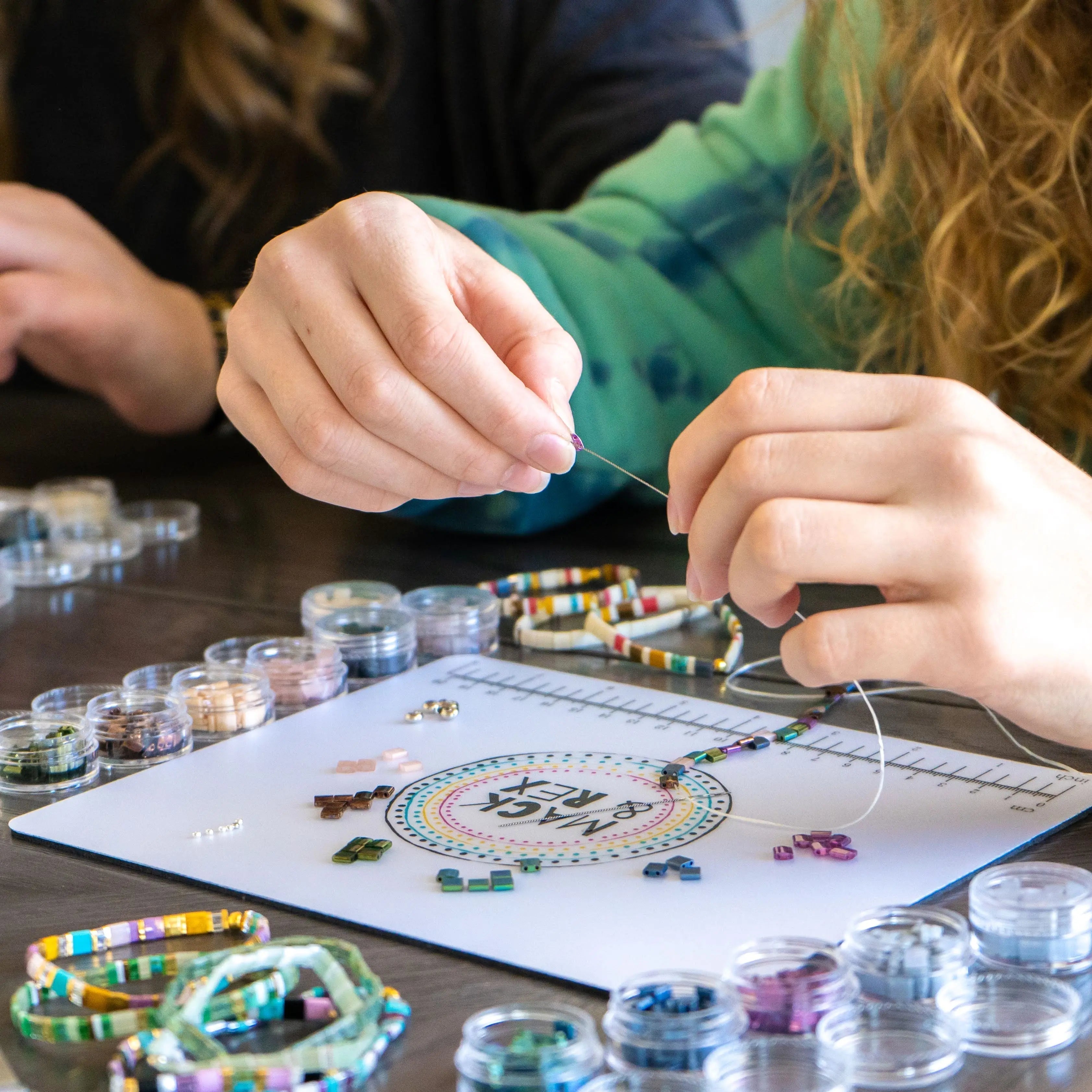
While you're testing, check your beads too. Tila beads are flat, two-hole rectangles from Miyuki, a third-party Japanese bead brand that Mack & Rex resells. They're strung on two strands, which changes how a charm sits. If you're building a Tila bracelet, a charm usually lives on the cord at the center of the bracelet or on a short end section rather than being threaded through the beads themselves, so it's worth deciding where it goes before you cut your cord.
Which stretch cord size works best with charms?
For most bracelets, 0.7 to 1.0 mm elastic is the sweet spot. Pick the thickest cord that passes through your smallest bead or charm opening without forcing. Thicker cord holds up better to the pull of charms, but only if it actually fits through everything on the bracelet.
This is the tradeoff nobody mentions. You want a thicker cord for strength, and you want a thinner cord to fit tight charm openings. The smallest opening on the bracelet decides. If one charm forces you down to 0.5 mm cord, the whole bracelet ends up on thin elastic. Better to pick a different charm than to weaken the bracelet around it.
Doubling the cord is another option when your openings are generous. It adds strength, but it also doubles the width you need to fit through the hole, so only do it when the opening has room to spare.
What's a good way to choose charms that look right?
Pick one theme and one finish per bracelet. Three or four small charms in one color family look intentional, while a mix of sizes, metals, and styles looks cluttered. Match charm size to bead size so the charm doesn't overwhelm the pattern or disappear into it.
A few pairings that work well:
- Bows with soft, tonal bead colors for a gift-ready bracelet. The BOWS set gives you 20 pieces, so you can make several bracelets or keep a few spares.
- Marine or mermaid charms with blues, sandy neutrals, and white for a beach palette.
- Flower stems with greens and pastels for spring.
If you'd rather skip charm fitting and go straight to wearing, our finished bracelets are made and strung for you. Mack & Rex's "buy 3 bracelets, get 1 free" offer applies to finished bracelets only, and it doesn't apply to kits, beads, or charms.
How do you care for a stretch bracelet with charms?
Take it off before showers, swimming, and workouts, and keep lotion away from the cord. Charms add weight, and weight plus sweat and chlorine speeds up elastic wear. Store the bracelet flat, and check the knot and cord every few months.
A history of charm bracelets goes back centuries, and Wikipedia's charm bracelet entry traces how they became a personal keepsake. The modern stretch version keeps that spirit but swaps the clasp for elastic, which is exactly why fit matters so much more than it does on a chain.
Are charms safe for kids to craft with?
Charms are small parts and a choking hazard for young children. If kids are crafting with you, an adult should supervise the whole time, keep charms and beads away from very young children, and put finished jewelry out of reach of anyone who still puts things in their mouth.
Bracelet making is a fun thing to do with older kids and grandkids, and the charm stage is usually their favorite part. Just keep the small pieces in a tray or a lidded container, count them at the end, and sweep the table before anyone wanders off.
Does Mack & Rex ship charms internationally?
Yes. Mack & Rex ships internationally, and shipping plus any customs or duties are calculated at checkout. Free shipping applies to US orders over $100. A single charm set won't reach that threshold on its own, so expect to pay shipping on a small order.
Ready to add a charm to your next bracelet?
Start with a set you can test. The BOWS 20pcs Bracelet Charms are $12.99, and 20 pieces gives you room to try a few placements and still have extras. Before you string anything, check the listing for the opening size, run your cord through one charm, and see how it moves. If it slides freely, you're in good shape.
Pair them with beads and elastic you already trust, or browse everything at Mack & Rex to build a full project. Spread happy.
Frequently Asked Questions
Can any charm go on a stretch bracelet?
No. A charm has to have a hole or bail large enough for your elastic cord to pass through, or it has to attach with a jump ring or a bead it can hang from. Typical stretch cord runs 0.7 to 1.0 mm, so check the opening before you buy.
What size stretch cord do I need for charms?
Use the thickest cord that passes through your smallest bead or charm opening without forcing. For most bracelets that lands between 0.7 and 1.0 mm. If the charm opening is tight, test the cord on the charm before stringing the whole bracelet.
Are bracelet charms safe for kids?
Charms are small parts and a choking hazard for young children. Adults should supervise any kids crafting with charms and beads, and finished jewelry should stay away from very young children.
Does Mack & Rex ship internationally?
Yes. Mack & Rex ships internationally, with shipping and any customs or duties calculated at checkout. Free shipping applies to US orders over $100.