

Are Gold Ball Bracelets Worth It? Gold-Filled vs Plated Buyer's Guide
Are gold ball bracelets worth buying?
Yes, for most people who want an everyday gold accent without paying solid-gold prices. A gold-filled or well-made gold-plated ball bracelet holds its color through daily wear better than cheap costume jewelry, and it costs a fraction of what a solid 18K piece runs.
The catch is that "gold ball bracelet," or "ball bracelets gold" if you're searching the other way around, covers a wide range of quality. Two bracelets can look identical in a photo and behave completely differently after three months on your wrist, because one has a thick, bonded layer of gold and the other has a coating a few atoms thick. That difference is what this guide is actually about: not whether gold ball bracelets are worth it in general, but which kind is worth it for how you actually wear jewelry.
What does "gold-filled" actually mean?
Gold-filled jewelry has a solid layer of real gold mechanically bonded, under heat and pressure, to a base metal core, usually brass. It's not a coating painted or dipped on. The gold layer has to meet a minimum weight, typically 1/20th of the total metal by weight, which is dramatically thicker than plating.
That thickness is the whole point. A gold-filled bead can get worn, bumped, and rubbed against other jewelry for years before the base metal has any chance of showing through. It costs more than plated pieces because more actual gold goes into making it, but it's nowhere near the price of solid gold since the core is still base metal.
What does "gold-plated" mean, and how is it different?
Gold-plated jewelry has a thin layer of gold applied to a base metal through electroplating, an electrochemical process that deposits gold atoms onto the surface. That layer is measured in microns, not weight percentage, and it can range from barely-there flash plating to a thicker coating that holds up reasonably well.
Here is the part that trips people up. A gold-plated bracelet can look every bit as bright as a gold-filled one on day one. The difference shows up over months, as normal friction, lotion, and sweat slowly wear the surface layer thin in the spots that rub most, usually where the bracelet contacts your wrist bone or a watch. Thicker plating buys more time before that happens. Thin flash plating can start to fade within weeks of daily wear.
What about gold vermeil or "gold-tone"?
Vermeil is a specific kind of gold plating, applied over a sterling silver base instead of brass or steel. In the US, a piece can only be called vermeil if the gold layer meets a minimum thickness, generally 2.5 microns, which puts it a step above standard flash plating even though it is still a coating rather than solid gold through and through.
"Gold-tone" is the vaguer term. It just means the piece looks gold. It could be gold-plated, it could be an alloy that reads gold without any actual gold content, and the only way to know for sure is to check the specific product listing. When a description doesn't name gold-filled, gold-plated, or vermeil directly, treat it as gold-tone and ask before assuming.
Will a gold-plated bracelet turn your wrist green?
Sometimes, yes. It can happen once the plating has worn thin enough to expose a reactive base metal underneath. Skin oils, sweat, and moisture interact with certain alloys and produce that greenish discoloration. It's a base-metal reaction, not a gold reaction. Pure gold doesn't tarnish or react with skin.
Thicker, better-quality plating over a stable base metal delays this for a long time, and gold-filled pieces resist it almost entirely because the gold layer is so much thicker to begin with. If you have had trouble with cheap costume jewelry discoloring your wrist before, a gold-filled bracelet is the safer bet. Sensitive skin still varies person to person, so if you know you react to certain metals, check what the base metal is before buying rather than assuming any "gold" label solves it.
Can you shower, swim, or work out in a gold ball bracelet?
Depends on the piece. Check the specific product page before you plan on wearing it 24/7. Some finished gold-filled ball bracelets are listed as waterproof, meaning the maker built them expecting daily wear through showers and workouts without damage to the finish. Plated pieces vary more. A well-plated bracelet can usually survive a shower now and then, but chlorine, salt water, and harsh soap will wear any plating faster than plain daily life does.
If you want a true never-take-it-off bracelet, look for one explicitly described as waterproof or gold-filled rather than assuming. That single word in a product description tells you more about durability than the price tag does.
Which Mack & Rex gold ball bracelet should you pick?
Mack & Rex carries more than one version of the gold ball bracelet, and they aren't interchangeable. The accent bracelets collection lists a Gold Ball Bracelets style described on the product page as 18K gold plating over a heavy, solid steel bead, sold in bead sizes from 2mm up to 6mm and adjustable to fit larger wrists. A separate Gold Filled 3mm Ball Bracelet is listed as true gold-filled and waterproof, and there is a Rose Gold Filled 3mm Ball Bracelet built the same way for a warmer tone.
Prices across the line run roughly $20 to $30 depending on the style and bead size. That's squarely in everyday-bracelet territory, not fine-jewelry territory, which fits how most people actually wear a stacked accent piece: often, and without babying it. Because the finish and base metal differ by listing, check the specific product page for the exact spec before you buy rather than assuming every gold ball bracelet on the site is built the same way.
One customer summed up the everyday-durability case well: "I absolutely love MackandRex bracelets! I order them all the time. I give them for gifts and I wear them everyday. The quality is excellent, I should know because I have some that I never take off and they last and still look just like new." That is the bar a gold accent bracelet needs to clear to be worth buying.
How do you stack a gold ball bracelet with a Tila bead bracelet?
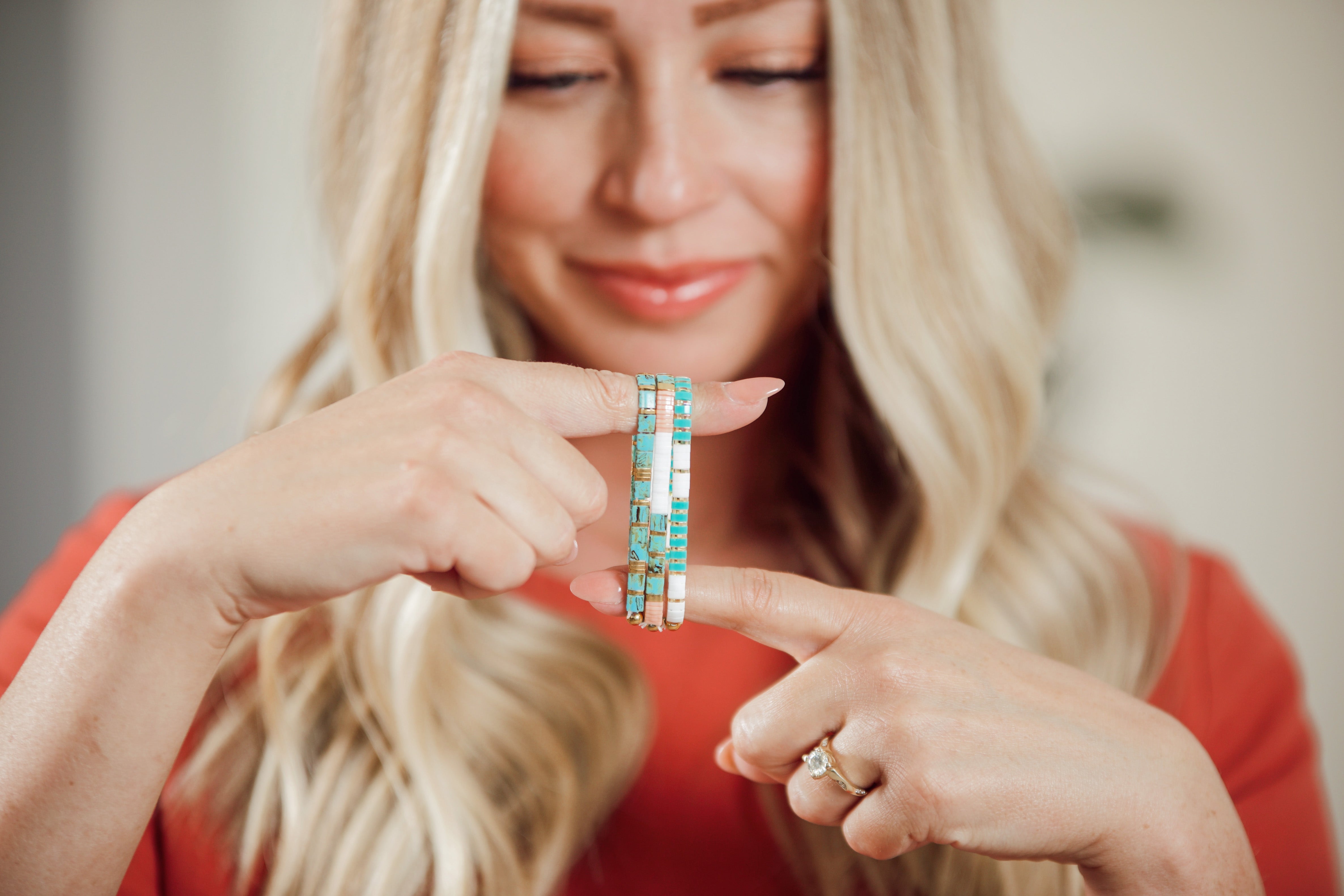
Treat the ball bracelet as the accent, not the centerpiece. A row of round gold beads breaks up the flat profile of Miyuki Tila beads and adds a bit of shine between two more matte or colorful rows. Three bracelets total, with the gold ball piece in the middle, is an easy default that reads intentional rather than random.
Warm-toned Tila mixes, mustard, golden topaz, warm cream, echo the gold nicely without matching it exactly. Cooler or darker Tila rows lean into the contrast. Either direction works. The gold ball bracelet is doing the same job a good accent always does: giving your eye somewhere to land in a stack of several pieces.
A small compliance note worth mentioning here: any offer that includes free bracelets applies to finished, ready-to-wear pieces like these, not to bead kits or loose bead mixes, so keep that distinction in mind if you are shopping across the full Mack & Rex catalog.
Frequently Asked Questions About Gold Ball Bracelets
Are gold ball bracelets worth buying?
Yes, for most people who want an everyday gold accent without the price of solid gold. A gold-filled or well-made gold-plated ball bracelet holds its color through daily wear far better than cheap costume jewelry, and it costs a fraction of what a solid-gold piece runs.
What is the difference between gold-filled and gold-plated jewelry?
Gold-filled jewelry has a solid layer of gold mechanically bonded to a base metal, thick enough that it will not flake or wear through with normal use. Gold-plated jewelry has a much thinner layer of gold applied by electroplating, which looks the same at first but wears thinner over time.
Will a gold-plated bracelet turn my wrist green?
It can, if the base metal underneath is a low-quality alloy that reacts with skin oils and moisture, and it becomes more likely once the plating wears thin. Gold-filled pieces and plating over a stable base metal are far less likely to cause discoloration or irritation.
Can I shower or swim in a gold ball bracelet?
Check the specific product page, since it depends on the base metal and finish. Some gold-filled ball bracelets are listed as waterproof for daily wear, while plated pieces generally hold up better if you take them off before chlorine, salt water, or harsh soap.
Is gold vermeil the same as gold-plated?
Not exactly. Vermeil is gold plating over a sterling silver base rather than brass or steel, and in the US it must meet a minimum gold thickness to legally use the name. Standard gold plating can go over any base metal and has no required minimum thickness.
For more on how these finishes are defined, see the International Gem Society's guides to gold-filled jewelry and gold-plated jewelry, and Wikipedia's entry on silver-gilt (vermeil) for the sterling-silver-base version.
Ready to add a gold accent to your stack? Browse the gold ball bracelets, gold-filled styles, and full lineup on the Mack & Rex accent bracelets collection, and check each product page for the exact metal spec before you buy. Mack & Rex ships internationally, with shipping and any customs calculated at checkout, and US orders over $100 ship free. Buy 3 finished bracelets and get 1 free, no code needed.